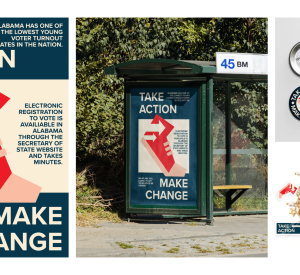
UN International Peace Day Poster: Typography as a Tool for Advocacy
Posted

Xiaodie Wang, Typography Class (ART-3325), Troy University
Gold & Judge’s Choice ADDY Award Winner at the 2025 regional American Advertising Awards

Icie Wallace, Typography Class (ART-3325), Troy University
1st Place Winner of the 2025 IAC’s Peace Parade Poster Competition

Kaleyah Gilbert, Typography Class (ART-3325), Troy University
2nd Place Winner of the 2025 IAC’s Peace Parade Poster Competition

Icie Wallace, Typography Class (ART-3325), Troy University

Anna Stallworth, Typography Class (ART-3325), Troy University
1st Place Winner of the 2026 IAC’s Peace Poster Competition
| Educator/s: | Thiffany Belda |
|---|---|
| Institution: | Troy University |
| Level: | Advanced, Senior, Undergraduate |
| Duration: | 2 weeks |
| Category: | Design Methods, Graphic Design, Social Innovation, Typography, Visual Communication |
| Filed Under: | BA Program, Community, Culture, Design for Democracy, Design for Good, Ethics, Four-year Program, Politics, Poster, Printed Matter, Social Impact |
| Bookmark Project | |
Project Brief
A typographic advocacy project that challenges students to translate global themes into clear, impactful visual communication through hierarchy, message, and form.
Design has the power to shape public dialogue and influence how people think about global issues. The United Nations International Day of Peace invites individuals and organizations around the world to reflect on the importance of peace, cooperation, justice, and collective responsibility.
This project asks students to create a typographically driven poster inspired by the annual Peace Day theme. Rather than relying primarily on imagery, students must explore how typography itself can become the primary visual voice of advocacy.
Students are challenged to translate an abstract concept such as peace into a compelling visual message that communicates urgency, empathy, and hope. Through this process they learn how typography can function not only as a system of organization, but also as a tool for persuasion and social engagement.
The assignment encourages students to consider how design can participate in global conversations while maintaining clarity of message and strong visual impact.
SPECIFICATIONS
Format
Poster size: 11 × 17 inches
Resolution: 300 DPI
Primary software: Adobe Illustrator
Poster\'s Requirement
Typography must function as the primary visual component of the poster. Images or graphic elements may be used sparingly, but the central message must be communicated through typographic form.
The UN emblem and their selected theme for the current year must be incorporated.
Students must also consider layout, hierarchy, and spacing in order to create a design that communicates clearly at both close and distant viewing ranges.
PROCESS
Step 1: Research
Students begin by researching the concept of Peace Day and the theme for the current year. This step encourages them to think critically about how global issues are communicated visually.
Step 2: Concept Development
Students define the message their poster will communicate and explore how tone, language, and typographic choices support that message.
Step 3: Sketching and Layout Exploration
Initial sketches focus on typographic hierarchy, composition, and visual rhythm.
Step 4: Poster Development
Students refine their concept in Adobe Illustrator, experimenting with scale, contrast, and spacing to strengthen the poster’s message.
Step 5: Reflection
Students write a short reflection discussing what peace means to them and how their design communicates that idea.
Learning Objectives
- Explore typography as a tool for social communication and advocacy
- Develop a typographic poster that communicates a clear message and call to action
- Strengthen understanding of hierarchy, scale, and visual emphasis
- Translate complex social themes into accessible visual narratives
- Practice professional poster design workflows and presentation methods
Deliverables
Students submit:
- A a high-resolution 11 × 17 inches printed poster
- A Process Book PDF including:
- Cover page with project information
- Moodboard or visual references
- Final poster design applied to a mockup to demonstrate real-world application and context
- Written reflection: What Does Peace Mean to You?
Students also submit a packaged Adobe Illustrator file.
Readings/Resources
- UN EMBLEM https://www.un.org/en/about-us/un-emblem-and-flag
- What is the United Nations? https://youtu.be/E67ln5yJtyE?si=Q6XAf39HcRpGhjIq
- Is Graphic Design The Most Powerful Visual Medium? https://youtu.be/YJ_mzSnQN3s?si=JAjXPolKIfbLGj-G
Reflections
Poster assignments provide an effective framework for teaching typography because they require students to balance concept, hierarchy, and visual impact within a single composition.
Using the International Peace Day theme introduces a real-world context that encourages students to think beyond purely formal design concerns. Students begin to see how their talents and typography can participate in broader cultural conversations and how visual communication can influence public awareness.
The assignment also reinforces an important pedagogical goal: helping students understand that typography is not only about arranging letters, but about communicating ideas with clarity and intention.
RECOGNITION & IMPACT
Student work developed through this project has been selected for awards and to participate in the IAC Peace Day Parade, for exhibition in local student showcases at the Johnson Center for the Arts (JCA) and has been featured in university media coverage, including the campus newspaper and the university television channel. Furthermore, student work was recognized for it’s excellence at the 2025 regional American Advertising Awards (ADDYs) in the Dothan chapter, receiving a Gold & Judge’s Choice ADDY Award.
These recognitions highlight how classroom assignments can generate work that resonates beyond the class environment and engages a broader community audience.
EDUCATOR'S PORTFOLIO: https://www.tbelda.com/